
Jeroen Heijneman and Lianda Leeggangers
Scenario Analysis Breaking? Banks need decision-grade capabilities
Introduction
Recent financial stability publications across Europe point to a clear shift in the nature of risk. The ECB highlights in its latest 2026 Financial Stability Review that the euro area is now exposed to “acute geopolitical risks”, combined with energy shocks, trade fragmentation and cyber threats. Together, these factors create a more complex and uncertain environment.
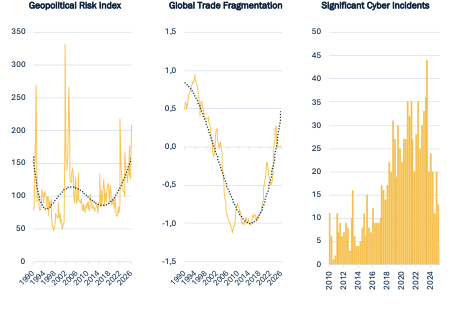
Sources: Caldara and Iacoviello (2022), Fernández-Villaverde (2024), CSIS (2026). Geopolitical Risk Index (GRI) and Global Trade Fragmentation (GTF) is shown on a quarterly basis. Geopolitical Risk Index is 90-day moving average.
Similarly, CPB (2026) underlines that geopolitical tensions propagate through multiple channels simultaneously, i.e., market volatility, credit risk and cyber threats, rather than through isolated pathways. DNB (2026) further characterises the current regime as one in which “new shocks follow each other rapidly” and uncertainty reaches historically elevated levels, reinforcing the need for robust scenario analysis and stress testing.
A notable additional observation is the contrast between macroeconomic uncertainty and market behaviour. Financial markets remain relatively stable despite elevated risk, suggesting that downside risks may not be fully priced and that abrupt repricing remains a credible scenario.
Taken together, supervisors are effectively signalling that:
- Risks are cross cutting, multi channel and compounding
- Transmission is faster and less predictable
- Parts of the system are less transparent (e.g. private credit, AI financing)
This creates a structural tension with scenario and modelling frameworks that were designed for slower, more linear and more observable risk dynamics. The implication is not that scenario analysis is becoming obsolete. Rather, traditional, compliance driven approaches, often organised across separate risk functions, are increasingly struggling to keep pace with how risk now behaves.
What has changed
First, risks are becoming more interconnected. Geopolitical tensions, energy shocks, financial market dynamics and technological developments increasingly reinforce one another across multiple transmission channels.
Second, the speed of change has increased materially. Financial conditions can tighten or reprice within short timeframes, while scenario processes often remain anchored in annual cycles. DNB (2026) highlights that shocks now “follow each other rapidly”, reinforcing the need for more timely analysis.
Third, supervisory expectations are rising. The focus is shifting from whether scenarios exist to whether they meaningfully inform decision making across capital, liquidity, risk appetite and portfolio steering.
Against this backdrop, the core challenge is no longer to produce more scenarios and narratives. It is to ensure that scenarios remain relevant, coherent, meaningfully consistently quantified, and usable in decision making.
Where scenario analysis breaks today
In practice, four recurring failures are emerging in discussions with finance and risk practitioners.
1. Governance and steering gaps
Institutions are increasingly expected to demonstrate clear governance over assumptions, expert judgement and model limitations, including evidence of effective challenge and escalation. Yet, scenario outputs often fail to translate into actionable steering decisions:
- Banks may run climate scenarios for ICAAP, yet sector concentration limits or portfolio steering thresholds remain unchanged.
- Transition narratives are developed, but capital sensitivity and earnings volatility are not recalibrated accordingly.
- Group level scenarios exist, while local subsidiaries struggle to demonstrate relevance to their own balance sheets and SREP discussions.
A key contributor is that cross cutting risks require consistency across credit, market, liquidity and operational risk, while expertise and governance remain organised along these same risk lines. This makes it difficult to produce firm‑wide, internally consistent stress outcomes, and even harder to link them to clear management actions.
The result is a persistent disconnect between analysis and steering.
2. Speed and operating model constraints
Scenario analysis remains often slow and too bespoke relative to the environment it seeks to assess. In many institutions:
- Scenario execution depends on manual processes and fragmented tooling
- Outputs are produced through complex, one off analyses
- Reuse across regulatory and management use cases is limited
This raises a practical challenge:
How can banks generate scenario impacts in a repeatable, scalable and non-complex way?
When execution becomes the bottleneck, frequency declines while market conditions evolve rapidly. This is particularly problematic in an environment where financial conditions can tighten quickly following shocks, such as energy price increases or geopolitical escalation.
In practice, four recurring failures are emerging in discussions with finance and risk practitioners.
3. Data and lineage weaknesses
Supervisory credibility depends less on model sophistication and more on the ability to explain assumptions, governance choices and management actions coherently. However:
- Data foundations are often fragmented
- Key inputs (e.g. sector data, geolocation, non bank exposures, energy performance) remain incomplete
- Decision to data lineage is not always clear
These issues become more pronounced as risk visibility declines. For example, private credit exposures often lack transparency and have unclear interconnections.
Without clear traceability from assumptions to outcomes, scenario results become harder to defend and less credible for decision making. Read more on persistent data management challenges in our blog on BCBS239.
4. Methodology and model risk limitations
Scenario quantification often lacks consistency at the point where it matters most: aggregation.
While individual models may be robust, in practice:
- Credit, market and liquidity models operate on different assumptions and datasets
- Second round effects and feedback loops are only partially captured
- Outputs are difficult to reconcile into a coherent firm wide view
This leads to incomplete quantification, inconsistencies across risk types, and a limited ability to capture interactions between shocks. Supervisory analysis increasingly emphasises that interconnected risks can amplify shocks across markets and institutions, reinforcing the need for coherence across modelling domains.
This should not be misinterpreted as a call for full quantification. Some risks are inherently unquantifiable. Attempting to impose false precision risks obscuring uncertainty rather than managing it.
Implications for banks
The challenge is typically not the absence of scenarios, but ensuring that scenario analysis remains proportionate, coherently quantified, repeatable and fully integrated into decision making processes.
Five implications stand out:
- Consistency across risk types matters more than depth within individual models. Cross cutting risks require aligned assumptions and coherent aggregation.
- Repeatability matters more than analytical sophistication. Scenario processes must be executable frequently, not only accurately.
- Exhaustive coverage is the wrong objective. Attempting to model every emerging risk dilutes focus and increases model risk.
- Judgement must be explicit and defensible, particularly where data is incomplete or risks are opaque.
- Integration into decision making is critical. Without it, scenarios remain compliance artefacts.
Rebuilding scenario analysis
Scenario analysis needs to evolve from a periodic analytical exercise into a decision grade capability.
This implies three shifts. First, from siloed analysis to cross‑risk coherence. Scenarios should be designed around consistent assumptions and transmission channels across all risk types.
Second, from bespoke execution to repeatable operating models. Scenario capabilities should be modular, reusable across use cases, and supported by a simplified technology stack.
Third, from outputs to decisions. Scenarios should explicitly inform capital and liquidity buffers, portfolio steering and risk appetite.
The objective is not to predict outcomes, but to enable timely and defensible decisions under uncertainty.
Conclusion
Volatility, emerging risks and supervision are exposing the limits of traditional scenario analysis. Rebuilding scenario analysis as a decision grade capability is a prerequisite for defensible ICAAP, ILAAP and SREP outcomes, and for effective steering under uncertainty.
A pragmatic starting point is a focused diagnostic: assessing scenario capabilities against supervisory expectations, identifying priority gaps, and setting a proportionate roadmap. Done well, this creates clarity on where modelling is essential and where structured judgement delivers greater value.
This forms the basis for simpler processes, faster scenario refresh cycles, more sustainable data lineages, and stronger integration into decision making.
How can Mount help you
Mount supports banks in rebuilding scenario analysis as a decision grade capability by focusing on prioritisation, explicit judgement and decision to data traceability.
We start with a targeted diagnostic that identifies where scenarios fail to inform capital, liquidity and balance sheet decisions, and translate emerging risks into supervisory defensible financial impacts. Where specialist modelling is required, we orchestrate it. Where it is not, we ensure that judgement is explicit, structured and challengeable.
Don’t hesitate to contact us if you would like to learn more.
Want to know more?
We like to talk about our business and how we can help you!