
Aleksandra Filipowicz, Brune Riemeijer and Thijs Peeters
Finance Function Transformation – Enhancing the Finance IT landscape (part 1)
Introduction
Financial institutions must obtain and maintain licenses to operate within their jurisdictions, which involves managing regulatory compliance amid evolving and expanding requirements. From the perspectives of the Chief Financial Officer (CFO), key objectives for maintaining the license to operate include, among others, operational improvement.
In our article of March 9, 2026 ‘BCBS239: Why governance is the only sustainable path’, we addressed the CFO’s accountability as data owner, and from that position, its responsibility for data quality and lineage.
This article describes the exercise to enhance the IT landscape supporting the finance function of a financial institution, among others, for responsibilities as part of data ownership. What are the main drivers initiating changes, what options does the CFO have in the wonderful world of ledger systems, and how the CFO must navigate in this world getting to the best choice for the organization. Part 2 will focus on the implementation of the systems, once selected.
Why CFOs Replace Their Current Finance IT Systems
CFOs often decide to replace their existing finance IT systems for several key reasons. One primary driver is the need to support organizational growth and scalability; legacy systems may struggle to handle increased transaction volumes or complex reporting requirements as the business expands or changes. Additionally, outdated systems can hinder efficiency due to slow processing speeds, limited automation, and poor integration capabilities with other modern business applications.
Another significant factor is the demand for enhanced data accuracy and real-time insights. Modern finance IT systems provide advanced analytics and reporting tools, enabling CFOs to make more informed decisions. Regulatory compliance is also a crucial consideration; new systems are often better equipped to handle evolving financial regulations and security standards. Ultimately, replacing finance IT systems allows CFOs to drive digital transformation, improve operational efficiency, and maintain a competitive edge in an ever-changing business landscape.
Making the right choices from a concrete foundation
To pick the system and respective vendor that suits best, CFOs must be crystal clear for the strategic objectives of the organization’s finance function.
The strategic objectives of the modern CFO of a financial services institution (‘FSI’) extend well beyond traditional financial stewardship. They focus on driving organizational growth, ensuring regulatory compliance, and optimizing operational efficiency. A modern CFO aims to leverage technology to enhance data accuracy and provide real-time insights, supporting informed decision-making and agile responses to market changes.
Additionally, the CFO prioritizes digital transformation by replacing legacy systems with scalable, integrated solutions that foster innovation and streamline processes. Ultimately, the modern CFO seeks to create value for stakeholders by balancing cost control, performance improvement, and strategic investments in the finance IT landscape.
Subsequently, the – targeted – Finance (and Risk) business and IT architecture, designed from these objectives and the organizations design principles, is the foundation for the selection criteria, picking the right systems, and picking the right vendor.
| Criteria | Description |
| Functional Coverage & Compliance Readiness | The system should support comprehensive accounting and financial management functions, including multi-entity consolidation, multi-currency handling, and automated journal posting and finally ensuring accurate financial statements and audit readiness. The solution should facilitate adherence to financial regulations and industry standards IFRS and local GAAP standards) and, offering robust security features to protect sensitive information. |
| Scalability and Performance | The system must handle increasing transaction volumes and support future growth without compromising speed or reliability. |
| Integration & Data Model | The solution must integrate seamlessly with core transaction systems within the FSI, operational finance and treasury systems, enabling automated data feeds and reconciliations. A unified, transparent data model with clear audit trails and drill-down capability is essential for financial control. |
| Data Accuracy and Real-Time Reporting | Advanced analytics and instant access to financial data allow for timely and informed decision-making. |
| Flexibility & Adaptability | The platform should easily adapt to changes in accounting policies, reporting structures, or new business products without heavy customization. Modular configuration and periodic updates should support long-term scalability. |
| User Experience and Accessibility | Intuitive interfaces, customizable dashboards, and remote accessibility help ensure user adoption and productivity. |
| Vendor Support & Local Expertise | Strong implementation expertise and local presence are key. Vendors should demonstrate experience in accounting deployments for European or Benelux-based banks and offer responsive support through regional partners. |
| Implementation Effort & Total Cost of Ownership | The solution should balance functional depth with efficient implementation. Deployment should be cost-effective, leveraging standard modules rather than extensive custom development. Consideration of initial investment, ongoing maintenance, support costs, and potential for future upgrades is crucial for budgeting and long-term planning. |
| Market Proven Stability & Security | The platform must ensure stability and high performance for large transaction volumes. Proven references from leading financial institutions, along with strong data security and system reliability, confirm vendor credibility. |
Evaluating these criteria will help CFOs select a ledger system that supports organizational goals and drives operational efficiency.
Scoping the selection – The Structure of Accounting Systems in an FSI
In an FSI environment, accounting systems operate on two main levels. Each level serves as a distinct function within the financial data flow.
- Core General Ledger
These systems constitute the central accounting backbone of an FSI.
They aggregate and reconcile financial data from multiple sub-ledgers into a single, unified General Ledger (GL), ensuring accuracy, consistency, and compliance with accounting standards such as IFRS and GAAP.
- Sub-ledger Systems
These systems operate at the product or business-line level, recording detailed accounting entries for specific products such as loans, deposits, investments, insurance policies and cash flows, collections, or payments.
They capture operational transactions from product systems and transmit aggregated data to the Core General Ledger for financial control and reporting.
In some modern architectures, FSI’s also use dedicated accounting engines, specialized applications that generate accounting entries from business events (such as loan origination or trading activity) and feed them into the sub-ledger or General Ledger. These engines help standardize accounting logic across products and support complex regulatory frameworks, such as IFRS (e.g. IFRS 9 and IFRS 17), local GAAP requirements, and supervisory reporting expectations, by centralizing rule-based posting, valuation logic, and accounting event processing.
The interaction between these two layers can be illustrated through a general overview of the accounting data flow in an FSI. The diagram below shows how financial information typically moves from customer transactions through product systems and into the central General Ledger, culminating in financial reporting
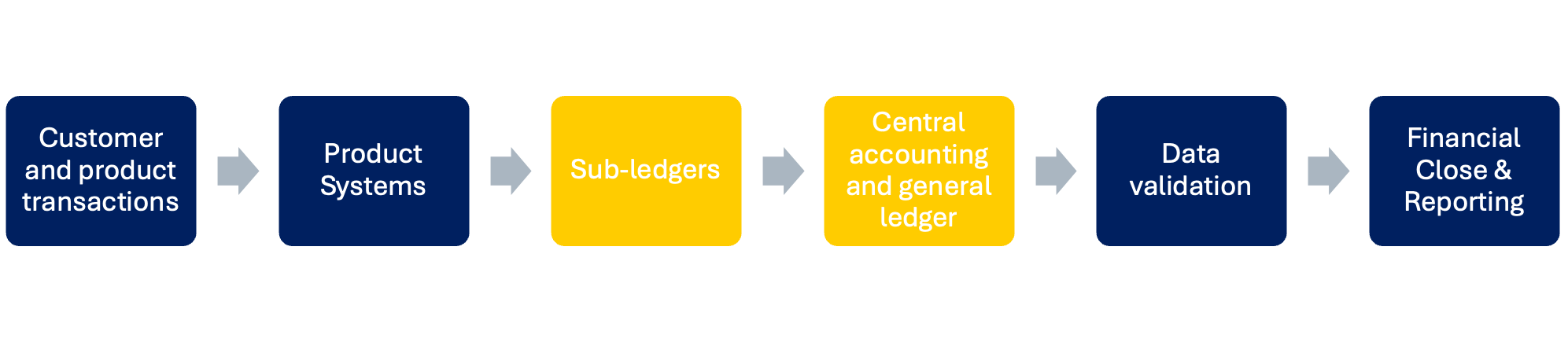
Note: Product systems represent operational banking and insurance platforms (e.g., loans, deposits, trading, insurance policies), while sub-ledgers are accounting engines that translate product data into accounting entries.
| Process Step | Description |
| Customer and product transactions | Customer and business operations that create financial/transactional events such as deposits, loans, or payments. Starting point for all accounting entries. |
| Product systems | Operational systems that record and store detailed transactions for each product line (e.g., loans, deposits, trading, insurance policies, investments). These systems provide source data for accounting and feed events into sub-ledgers through accounting rules. |
| Sub-ledgers | Accounting engines that transform product system events into accounting entries using predefined rules. Sub-ledgers maintain product-specific balances and feed aggregated postings into the general ledger. |
| Central accounting and general ledger | The core financial system of the FSI that collects and consolidates accounting data from all product systems. Ensures double-entry accounting and produces a balanced, organization-wide financial view. |
| Reconciliation and data validation | Compare and validate balances between sub-ledgers and the General Ledger to ensure consistency. |
| Financial Close and reporting | Finalizes accounting for the period and produces key financial reports such as Balance Sheet and Profit & Loss with dimensional breakdowns. |
What is an accounting system in an FSI
An accounting system in a FSI is the central software environment that records, classifies, and reports all financial transactions. Its purpose is to provide a single, accurate, and auditable source of financial truth for the institution. Each event that affects the FSI’s finances such as a premium payment, loan repayment, or trading operation generates an accounting entry within this system. In practice, a complete accounting system supports key finance functions such as product-level accounting for insurance, loans, deposits, and investments, along with cash and asset management. These processes ensure that all financial events flow consistently into the General Ledger. These entries must comply with strict accounting principles and standards such as IFRS or local GAAP, ensuring transparency and consistency across all operations.
How it works – the General Ledger as the core component
At the heart of the accounting system lies the General Ledger (GL), the bank’s primary accounting engine and authoritative record of all financial data. The GL aggregates information from multiple subledger systems, and consolidates them into a unified financial book. It applies double-entry accounting, where every transaction affects two accounts (a debit and a credit), keeping assets, liabilities, and equity balanced.
The GL organizes all entries according to a chart of accounts, grouping them into categories like assets, liabilities, income, and expenses. Supporting sub-ledger systems (for loans, deposits, or investments) capture detailed, product-level transactions such as payments, loans, treasury, or trading and send summarized data to the GL. This process provides the bank with a reconciled and comprehensive financial view.
Modern accounting platforms continuously synchronize data between the GL, subledgers, and operational systems, ensuring near real-time accuracy. They also automate critical functions such as reconciliation, financial close, and regulatory reporting. Many solutions allow transactions to be tagged with additional analytical dimensions, for example, by cost center or business line to support management reporting and performance analysis.
Because FSI’s operate under strict regulatory supervision, every accounting entry must be traceable through a complete audit trail. The accounting system therefore acts as the core financial platform but also as a control and compliance tool, safeguarding data integrity, transparency, and regulatory adherence.
To ensure this consistency, FSI’s must follow formal accounting frameworks such as IFRS (International Financial Reporting Standards) or local GAAP (Generally Accepted Accounting Principles). These frameworks define how financial transactions should be recorded and reported, ensuring that financial statements are comparable, transparent, and auditable across institutions and jurisdictions.
How can Mount help you
Mount Consulting can support you with developing the foundation for your selection process as well as the selection itself.
We have executed a market practices study on ledger systems for the Dutch FSI market, investigating the solutions of 14 vendors, with an established market presence in European financial services, offering solutions that enable compliance, regulatory and financial reporting requirements, data transparency and auditability, and operational efficiency in the accounting and reporting domains. Categorized on size of the buying institution.
Don’t hesitate to contact us if you would like to learn more.
Want to know more?
We like to talk about our business and how we can help you!