
Jeroen Heijneman and Harry van Sprundel
Simplification Is Not (Yet) Relief – Why Europe’s Reporting Reset Will Expose Data Fragility
Introduction
The regulatory narrative is clear, but incomplete
European regulatory reporting reform is often framed as simplification: fewer templates, fewer data points, and lower ongoing cost.
That narrative is directionally correct, but operationally incomplete.
Across the EBA’s simplification agenda and the ECB’s Integrated Reporting Framework (IReF) a more fundamental shift is underway:
Regulators are moving from managing reports to governing data once and reusing it across authorities.
This distinction matters. While the end state promises efficiency, the transition will first test whether banks are structurally prepared to operate in a data-driven supervisory model.
Coordinated transition: progressive but not synchronised
The shift: from reporting to data integrity
Across EBA’s reporting simplification, IReF and enabling initiatives such as BIRD, the supervisory model is evolving:
From | To |
Template-driven reporting | Data-driven reporting |
Aggregated outputs | Granular inputs |
Reconciliation | Consistency by design |
Output validation | Data integrity and lineage |
The long‑term principle is clear: “Define once, report once, share.” This is not a reporting reform in isolation. It represents a shift toward data-centric reporting, where consistency must be achieved at source level rather than reconciled at reporting level.
What this shift means for banks
This shift fundamentally changes how regulatory reporting needs to be organized internally. Under a data-driven model, control no longer sits in templates and reconciliation layers, but in:
- Consistent definitions across Finance, Risk and Treasury
- Explicit data ownership at element level rather than report level
- Traceable transformation logic from source to output
- End-to-end lineage, including adjustments and overlays
In other words, reporting becomes a function of how well data is governed upstream. This creates a much stronger dependency on the quality of the underlying data architecture. Where definitions diverge or transformations are opaque, issues are no longer absorbed through reconciliation, but surface directly in reported outputs.
Why the transition is structurally complex
While the direction is clear, the transition toward this model is not yet synchronized. The EBA is redesigning prudential reporting with first reporting under the revised framework targeted from September 2027. In parallel, the ECB’s IReF introduces a phased path with consultation in H2 2027, a pilot from Q2 2030 onwards, and first official reporting from Q2 2031. This will be followed by an initial parallel phase.
At the same time, implementation initiatives such as BIRD show that the integration question is not yet resolved. BIRD supports reuse and common transformation logic, yet key extensions remain work in progress.
This creates a structural reality:
- Prudential, statistical, and implementation layers move at different speeds.
- Integration points remain partly conditional
- Banks will need to operate across overlapping reporting logic during the migration.
Importantly, this lack of synchronisation is not just a timing issue. It increases complexity during the transition state and reinforces why simplification does not immediately reduce effort.
Taken together, this means that the reporting model is fundamentally changing, while the transition itself remains incomplete and uneven. This combination is critical, as it directly determines how and when the expected cost benefits of simplification can materialize.
Reporting cost is expected to come down, but not immediately and not automatically
The industry’s call and the regulatory response are aligned in principle: reporting costs are expected to decline over time. EBA simplification, IReF, and broader integration efforts aim to structurally reduce both run and change costs by enabling more efficient reporting through reuse, consistency and coordination.
However, the transition described in the previous chapter reshapes how these cost reductions materialize.
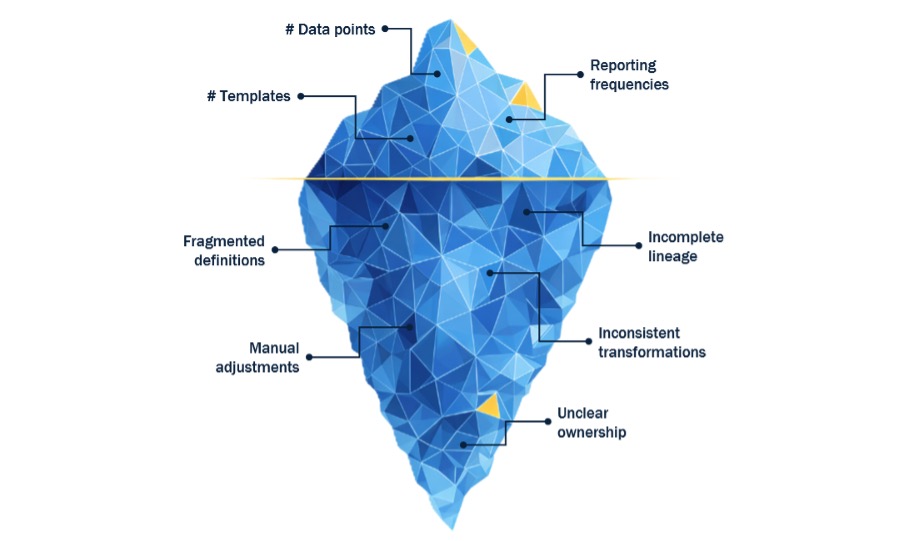
The key implication is that simplification does not eliminate complexity but rather changes where it resides. While reporting models may appear more streamlined at surface level, this simplification is largely confined to what is visible: templates, frequencies and data points. Beneath that surface, institutions must rely on more granular data, tighter controls, and more complex aggregation capabilities to produce consistent outputs.
In effect, the visual reporting layer represents only the tip of the iceberg. The underlying cost drivers sit below the surface. Simplification reduces visible complexity, but it also exposes these underlying structural drivers. Controlling and simplifying what sits below the surface is therefore where the largest cost efficiencies can ultimately be realised.
As a result, the timing and extent of cost reduction become conditional, not automatic. This creates a two-stage cost dynamic.
Transition cost elevation is likely
In the near to medium term, reporting costs are more likely to increase rather than decrease. This reflects not only internal transformation efforts, but also the not fully synchronised transition dynamics outlined in Chapter 2. Banks are required to move toward a datacentric operating model while regulatory frameworks continue to evolve at different speeds.
In practice, this results in:
- Banks incurring dual‑run costs as they operate parallel reporting logics across prudential and statistical domains.
- Banks introducing duplication of control and validation layers to ensure consistency across both legacy and emerging frameworks.
- Banks managing overlapping change programmes that combine regulatory implementation, data architecture redesign, and governance reinforcement.
- Banks maintaining continued reliance on existing reconciliation mechanisms while simultaneously investing in their replacement.
This combination creates a temporary increase in both run-the-bank and change-the-bank costs. Critically, this uplift is amplified by the lack of full synchronisation across regulatory initiatives. Banks must integrate new requirements into operating models that remain partially dependent on legacy structures, rather than transitioning in a fully clean, sequential manner. This is therefore not a deviation from the simplification objective, but a structural feature of the transition phase.
Long‑term savings are conditional on resolving structural data fragility
Over time, cost reduction can materialize, but only if underlying data constraints are addressed.
As outlined before, the new regulatory model depends on consistent data definitions, clear ownership of data elements, transparent and stable transformation logic and full end-to-end lineage (including adjustments). Its absence has clear, opposing cost implications:
- The organisation maintains consistent data definitions across Finance, Risk, Business and Treasury, enabling reuse of data across frameworks, whereas inconsistent definitions prevent reuse across reporting domains.
- The organisation establishes clear ownership of data elements, supporting reduced duplication, whereas unclear ownership perpetuates duplication and manual interventions.
- The organisation ensures transparent and stable transformation logic, enabling more efficient absorption of regulatory change, whereas unstable or opaque logic sustains elevated change costs.
- The organisation achieves full end-to-end lineage, including adjustments, reducing reliance on manual reconciliation, whereas incomplete lineage requires continued manual intervention and limits effort reduction.
In this sense, cost outcomes are not determined by the regulatory framework alone, but by the maturity of the bank’s data architecture and governance model.
Simplification creates the conditions for cost reduction but does not deliver it on its own.
The industry constraint: operating models remain template-led
The cost dynamics described in the previous chapter are not primarily driven by regulation itself, but by how banks are internally organized to deliver regulatory reporting. The fundamental constraint is structural: despite significant investment, many banks remain organised around reports rather than data.
In practice, we see that ownership is typically defined at the template level, lineage often stops at the point of report population, and manual adjustments are used to compensate for inconsistent definitions.
These practices are workable in a template-heavy regime but become increasingly fragile under reduced redundancy, greater granularity, and increased reliance on consistency by design.
How this plays out in practice: a phased adjustment
In operational terms, the transition toward data-driven reporting typically unfolds in three phases:
1. Exposure phase | 2. Stabilisation phase | 3. Efficiency phase |
|
|
|
The critical risk is expecting efficiency outcomes before structural data issues are resolved. Importantly, these phases are not theoretical. In practice, many of these dynamics are already visible in current reporting setups, particularly where data alignment across domains is incomplete.
A Dutch perspective: governance, not architecture, is the constraint
Based on Mount’s work on BCBS 239 and regulatory data programmes in the Netherlands, one observation is consistent. Centralised data platforms are often in place, but governance of definitions, transformations, and lineage remains uneven.
Typical patterns we observe include:
- Manual adjustments embedded in reporting processes.
- Fragmented logic across Finance and Risk.
- Limited transparency beyond final outputs.
A concrete example is the persistent mismatch between COREP and FINREP concepts at granular level. In many banks, these differences can still be reconciled downstream today. Under a more integrated and granular reporting model, they become structural issues rather than manageable reporting artefacts.
This creates a structural gap. Centralisation provides control, but not necessarily consistency, traceability, or reuse. Under simplified and more granular reporting, this gap becomes harder to absorb and more visible under supervision.
Diagnostic triggers for Heads of Regulatory Reporting
The relevant question is not whether reform is positive, but whether the bank organisation is prepared for the transition and reap all benefits. It also raises a broader question: whether regulatory reporting remains a standalone compliance function, or whether it becomes a reusable data foundation that supports steering and decision-making. The latter is only possible if data is granular, complete, timely, and trusted.
Heads of Regulatory Reporting should as such ask themselves:
Definition alignment |
|
Lineage transparency |
|
Control model |
|
Transition readiness |
|
Dependency exposure |
|
Conclusion
EBA simplification and ECB’s IReF should be understood as connected parts of the same structural transition: a move toward lower reporting cost through reuse, consistency, and coordination. Enabling initiatives such as BIRD indicate the intended direction of implementation, but also show that the practical path remains under construction.
The sequence matters. The first impact of simplification is not relief: it is transparency of structural data fragility.
Which leads to the more relevant executive question:
If simplification removes the buffers, are your data foundations able to carry the load?
How can Mount help you
Mount supports banks in translating regulatory reporting reform into a data‑driven operating model that is structurally sound, not just compliant. We start with a focused diagnostic that identifies where current reporting relies on reconciliation buffers, fragmented definitions and opaque transformation logic, and assess readiness for a simplified and more granular regime.
From there, we help design and implement end‑to‑end data governance, explicit ownership models and traceable transformation logic, aligned across Finance, Risk and Treasury. Where regulatory interpretation is evolving (e.g. IReF, BIRD alignment), we translate supervisory direction into practical design choices and implementation priorities.
The objective is not only to meet upcoming requirements, but to build a reporting capability where consistency, reuse and lineage reduce both execution risk and long‑term cost under continued regulatory change.
Want to know more?
We like to talk about our business and how we can help you!