
sena burcu sahin, RUTGER VAN DER KLAAUW & Majoke hegen
The Blind Spot: Intraday Liquidity Risk – End-of-day reporting is no longer enough
Introduction
Consider a treasury desk at 10:30 on an ordinary business day. A large payment falls due at 11:00, and the inflow expected to fund it has not arrived. The liquidity that could cover the payment exists, but it is trapped in another legal entity and cannot be moved in half an hour. Most likely, the day ends without incident. The inflow lands in the afternoon, the position recovers, and by close of business the end-of-day reports show a balanced position. What those reports will not show is the morning in between (Figure 1), when the desk had to draw on intraday credit or hold back less critical payments. Holding back payments can signal stress to the market, and counterparties may adjust their behavior in response, which can further increase intraday liquidity risk.
That gap between what the reports show and what the desk experiences is where intraday liquidity risk sits. European supervisory expectations in this area have risen, while many banks still rely on tools and operating models designed for end-of-day reporting. Banks are now expected to demonstrate, with evidence and governance, that they can actively identify, monitor and manage the risk.
The gap is solvable. It requires end-to-end thinking across governance and real-time data.
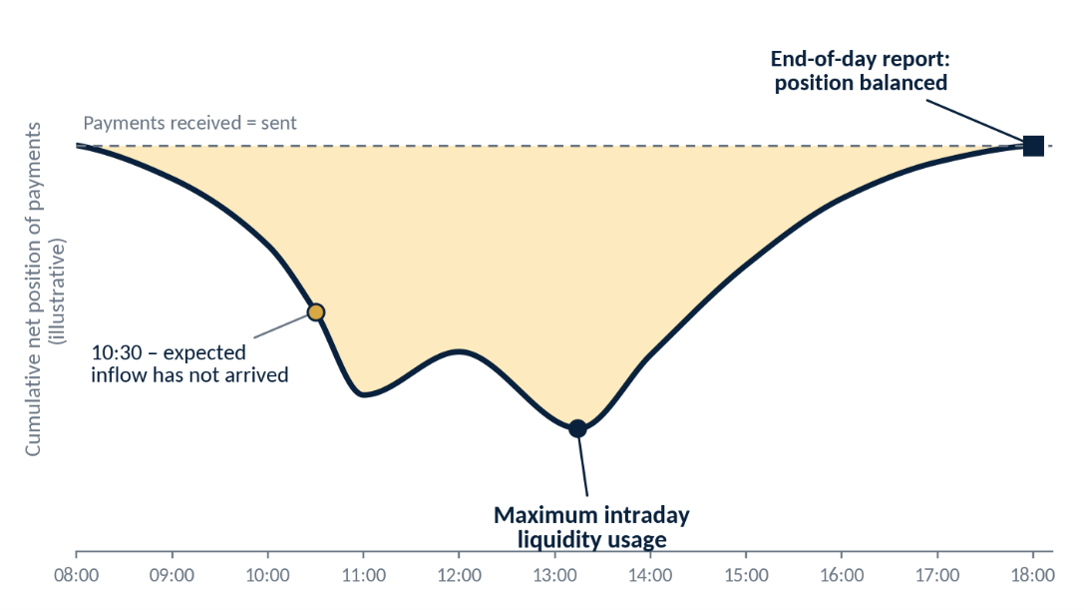
Figure 1
Illustrative intraday position: the end-of-day figure hides the peak. The lowest point of the curve is the maximum intraday liquidity usage, the peak funding need the bank must be able to cover during the day, even when its position recovers by close of business.
Why Intraday Liquidity Risk Demands Active Management
At 10:30 the desk did not lack liquidity. The bank held it, just not in the right place, in the right currency and at the right time. Three structural challenges make it hard to manage:
- Timing mismatches: Large time-specific obligations often settle early while inflows arrive later, but those obligations cannot be delayed.
- Liquidity constraints: Collateral may already be pledged, assets may be trapped in subsidiaries, and credit lines can tighten when they are needed most.
- Counterparty behavior: Delayed receipts, payment throttling and sudden margin requirements are outside the bank’s control.
These challenges have always existed, but today’s environment makes mismatches larger, faster and more frequent. Four drivers stand out:
- Instant payments remove end-of-day netting buffers and push settlement towards 24/7.
- Margin calls are same-day and time-specific.
- Social media can accelerate deposit outflows beyond what stress scenarios assume.
- ECB balance sheet normalization steadily reduces excess central bank liquidity, so banks need to manage their liquidity more actively.
These drivers leave little room for end-of-day thinking. Yet intraday liquidity itself is not a new topic. Basel asked banks to manage intraday positions actively as early as 2008 and introduced monitoring tools in 2013. What has changed is the standard of proof. Calculating a metric for a report is no longer enough. A bank is expected to demonstrate that it can monitor and steer its position at any moment of the day.
End-of-day reports are static. Managing intraday liquidity risk is dynamic.
Why Supervisors Are Now Looking At 10.30
The difference between static end-of-day reports and dynamic management under liquidity pressure was exposed during the 2023 banking turmoil, particularly in the case of Credit Suisse (CS). The Basel Committee examined the failures and near-failures of banks including Silicon Valley Bank (SVB) and CS in its report on the turmoil.
At CS, scandals and loss of confidence triggered deposit outflows in October 2022. US bank failures in March 2023 deepened the loss of confidence, while negative social media coverage and easy access to digital accounts accelerated withdrawals beyond stress assumptions. Intraday pressures compounded the problem with increased collateral and prepositioning demands, counterparties delaying payments to CS, and high-quality liquid assets (HQLA) trapped in entities unable to release them.
Yet CS continued to meet its Liquidity Coverage Ratio (LCR) and Net Stable Funding Ratio (NSFR) requirements throughout the crisis. These ratios were not designed for intraday risk. LCR measures liquidity at the end of the day over a 30-day horizon, so it cannot capture a failing payment or the intraday timing of margin calls.
At CS, the liquidity buffer that counted toward LCR was also needed for intraday liquidity.
The turmoil consequently raised questions about the coverage of intraday needs, the calibration of outflow assumptions and the transferability of HQLA across entities. In this context, the European Central Bank (ECB) published its Sound Practices for managing intraday liquidity risk in 2024. Intraday liquidity risk already forms part of banks’ Internal Liquidity Adequacy Assessment Process (ILAAP) and supervisory assessment under the Supervisory Review and Evaluation Process (SREP). The Sound Practices build on this established framework, providing a more detailed reference for banks and supervisors.
The Single Resolution Board (SRB) reinforces this from the resolution side. In its 2026 consultation on draft guidance for liquidity and funding in resolution, the SRB asks banks under its remit to estimate intraday liquidity metrics across the phases of resolution and to report liquidity data at short notice and at high frequency, including intraday.
These capabilities should be built and demonstrated in normal times, not during a crisis.
What Does Good Look Like?
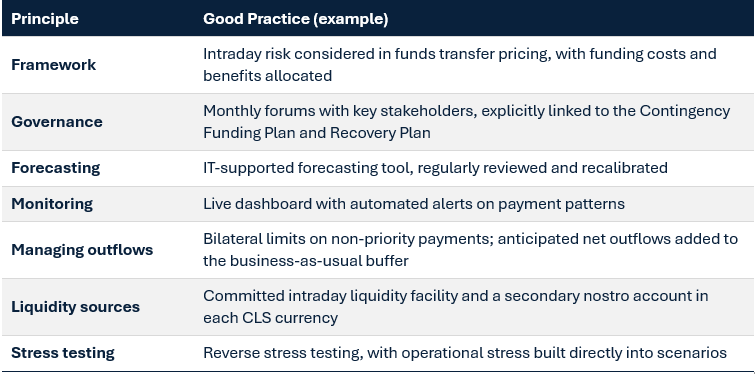
The ECB’s Sound Practices set out seven principles that build on one another, with Key Practices and Good Practices for each.
Key Practices are the fundamentals commonly observed across institutions, while Good Practices are the more advanced approaches that separate leading banks from the rest. The table below gives an example of a Good Practice for each of the seven principles. Figure 2 shows how the principles connect in practice.
As Figure 2 shows, the seven principles work as one chain. The framework defines how much intraday risk the bank is willing to run; governance turns that appetite into responsibilities and decisions; the daily workflow carries those decisions out. What the bank forecasts is what it monitors; what it monitors determines which payments to prioritize and which liquidity to mobilize; what it reports feeds back into its liquidity sources and stress tests, which in turn shape the next forecast.
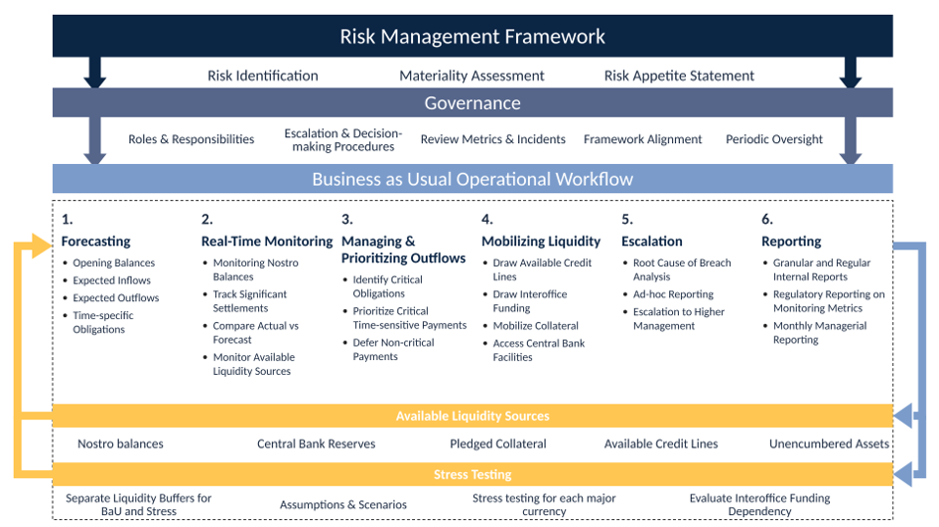
Figure 2
Intraday liquidity risk management: the seven principles mapped from framework to operational workflow
Data makes every step reliable. A forecast is only as good as the data behind it. Outflows can only be managed when the bank sees its payments, positions and collateral in real time.
Governance makes the steps work together by giving each step an owner and a trigger.
Beyond committees and policies, governance demands a culture of clear ownership of the intraday position and disciplined treasury hygiene. It requires people who know how to act and are prepared when an early warning indicator fires.
Upgrading one element in isolation, such as a new dashboard without clear ownership or reliable data, leaves the weakest link intact. Many banks fall short on both.
Two things hold this chain together: real-time data and governance.
Where Banks Fall Short
Back at the 10:30 desk, three things need to be clear immediately. The desk must know that an expected inflow is late, which liquidity sources and collateral can be released in time, and who decides what to prioritize. Market observations suggest that many banks struggle to establish this quickly, for familiar reasons:
- No clear ownership. Intraday liquidity spans several first-line functions (Treasury, Operations and Business Lines), with Risk providing second-line oversight. No single function is held accountable.
- Fragmented data and systems. Payment and collateral data sit across entities and currencies, with no single view of intraday capacity or trapped liquidity.
- Simplistic alerting and stress testing. Alerting is too simple to anticipate wider impacts, and stress scenarios ignore timing and mobilization constraints.
- Limited real-time visibility. Teams rely on end-of-day reporting and cannot see the position as it moves.
- Disconnected processes. Critical processes are not interlinked, so they fail under pressure.
What Falling Short Costs
- Intraday credit ties up collateral, overnight funding adds cost, and buffers set aside for intraday needs cannot be deployed elsewhere.
- Manual reconciliation and reporting take time away from actively managing liquidity. This might lead to escalation delays, buffers that cannot be used when needed, and missed time-specific payments.
- Weak evidence can draw findings in SREP and ILAAP, and HQLA used for intraday needs that are not available by the end of the day can push the LCR below its requirement.
Closing these shortcomings, however, is not a matter of copying a template, because every bank’s exposure looks different.
Which exposures are material depends on the business model:
- Retail banks are exposed mainly to deposit behavior, instant payments and retail payment peaks.
- Wholesale banks face large, concentrated, time-critical obligations.
- Investment banks face margin calls, collateral requirements and settlement deadlines.
- Global banks combine all of these across currencies, entities and time zones.
The starting point is therefore to understand which intraday drivers matter most for a specific institution.
Is Your Intraday Liquidity Framework Ready?
So where does your institution stand? Five questions provide a starting point:
- Can you monitor your liquidity position continuously throughout the business day?
- Can you forecast intraday liquidity needs with sufficient accuracy?
- Can collateral be mobilized quickly across entities and jurisdictions?
- Would your framework remain effective in a Credit Suisse-type stress event?
- Do your capabilities meet evolving supervisory expectations, not only today’s regulatory ratios?
How can Mount help you
Mount Consulting works across finance, risk and data, which lets us address intraday liquidity risk from every angle at once: the treasury’s view of positions, the risk function’s stress framework and the architecture of the underlying data. Our approach is to:
- Understand your business model and which intraday drivers are the most material.
- Assess your organization’s maturity against the seven principles.
- Decide where improvement matters most.
- Support you across all seven principles, through both consulting and analytics.
- Connect the functions and their different needs, so the capability works end to end.
Our credentials include ILAAP methodology, target operating model design and data infrastructure. The objective is not to make one part of the organization extraordinary. It is to make the entire capability work together at 10:30 and throughout the day.
Conclusion
Intraday liquidity risk can no longer stay a blind spot.
The question is not whether banks manage it, but whether they can demonstrate it.
That depends on how effectively they build the capabilities needed to do so.
Institutions that close these shortcomings will do more than satisfy supervisors. A mature framework with clear ownership and real-time management helps banks to:
- narrow their peak funding needs,
- lower funding costs and use collateral more efficiently, and
- improve operational resilience.
As a result, they strengthen decision-making under stress and position themselves for an increasingly real-time financial system.
What’s Next?
Start with the five questions in this paper. Any hesitation shows where to begin. Mount Consulting can help you understand which intraday drivers matter most for your institution, assess your maturity across the seven principles, and prioritize the improvements that count. We connect Treasury, Risk and Data so that the capability works end to end. To discuss where your institution stands, we would welcome a conversation.
Want to know more?
We like to talk about our business and how we can help you!