
RUTGER VAN DER KLAAUW, JEROEN HEIJNEMEN & ARTURO RICO TORRES
Liquidity Stress Testing for Committed Credit Facilities – A Bayesian approach to contingent liquidity risk
The Challenge
Committed Credit Facilities
Stable utilisation rates can hide the liquidity risk that matters most during stress.
Banks with significant wholesale lending portfolios carry large obligations through committed credit facilities. These are binding
promises to lend on demand. Until drawn, they remain off the balance sheet as contingent liquidity outflows.
Portfolio utilisation may appear stable, but facility level behaviour under stress can be highly uncertain. Underneath that stable average, a small number of large clients drawing heavily at the same time can produce extreme outflows.
A chain of factors makes this risk difficult to quantify. Extreme stress observations are scarce in the historical record. That scarcity
makes it difficult to link drawdown assumptions to macroeconomic scenarios. Banks therefore rely on expert judgement, which is often
difficult to substantiate or challenge. Additionally, significant challenges arise upon including such expert judgement within the
integrated stress testing framework consistently.
The Approach
From Synthetic Data to Stressed Outflows
Making committed credit facility utilisation assumptions in stress testing explicit, structured and challengeable.
The Mount Facility Stress Testing Framework
The Mount Consulting framework addresses the key challenges associated with assessing facility utilisation under stressed conditions.
First, by applying a common set of scenarios and credit risk drivers across multiple stress-testing exercises, the framework enhances consistency and coherence throughout the institution’s stress-testing landscape.
Second, while expert judgement remains an important element of the process, its influence is made more transparent and disciplined through the application of a Bayesian modelling approach. This model translates macroeconomic stress factors into statistically grounded facility utilisation paths, providing a robust link between economic conditions and utilisation behaviour.
Third, the result is a coherent and defensible approach. Facility utilisation behaviour under stress scenarios is supported by rigorous statistical estimation while remaining open to expert challenge and refinement.
Together, these elements create a comprehensive framework for stress testing across the whole institution.
Building and Testing the Framework
A – Hypothetical Portfolio
Real facility level data on extreme drawdowns is scarce and confidential. A synthetic portfolio provides the testing ground needed to develop and validate the framework against expected behaviour.
B – Output
The output tracks the utilisation rate for each facility over time, with the stress horizon adjustable to any desired level. The drawdown estimates are linked to scenario drivers shared across risk types, placing the results within a consistent macroeconomic narrative across the integrated stress testing framework.
Key Value Drivers of Our Approach
- Utilisation assumptions in stress testing becomes model-driven rather than purely expert-driven. Statistical inference and expert judgement on extreme behaviour work together, so neither is over-relied upon, which strengthens robustness.
- Aligning Liquidity Stress Testing inputs with Credit Risk inputs improves the quality of integrated stress testing, as scenarios become more consistent across risk types.
- More granular insight into portfolio risk drivers shows which facilities contribute most to outflow risk, so their management can be assessed.
The Value
Validating the Framework
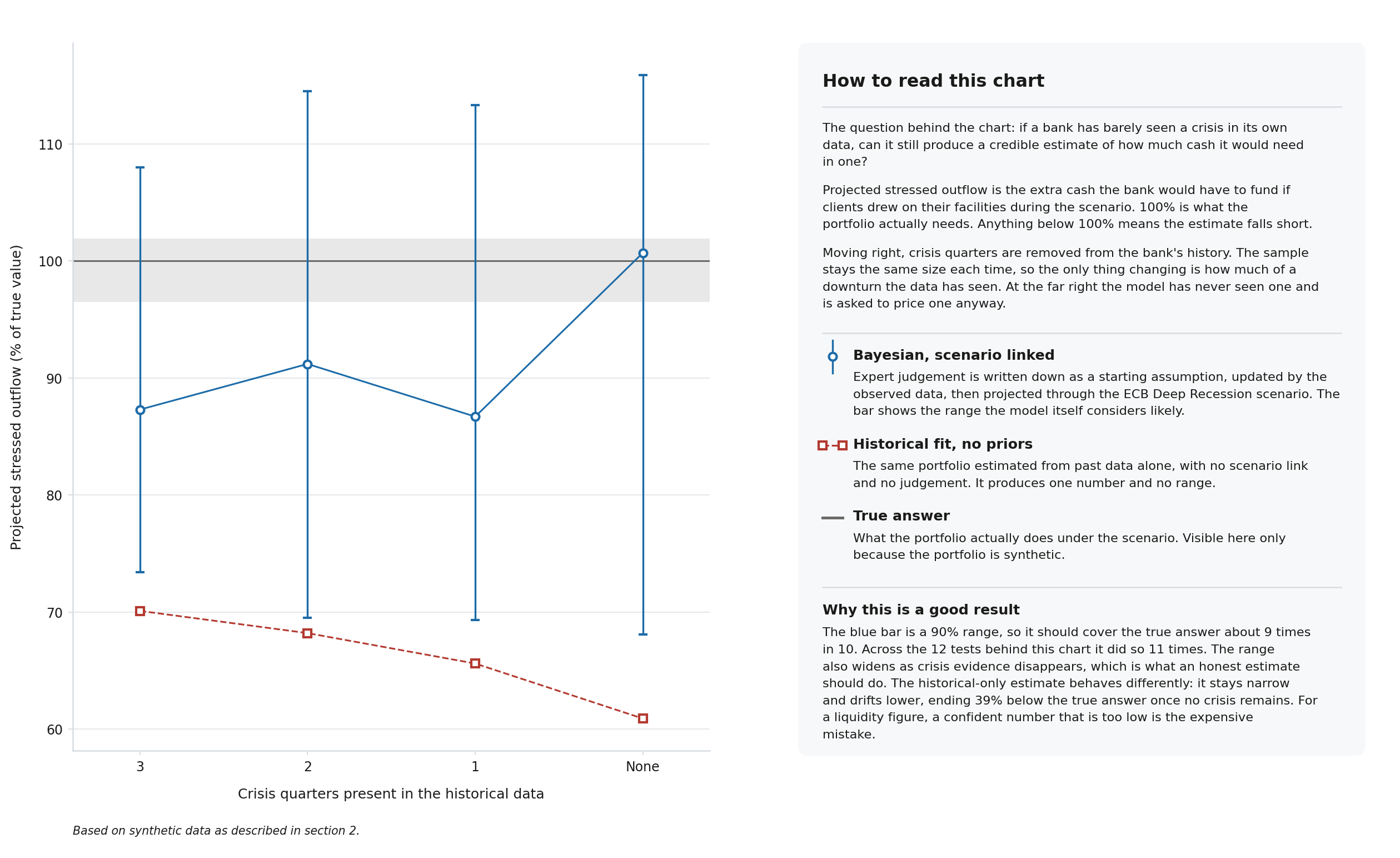
As evidence thins, the range of outcomes should widen.
As extreme observations become scarcer, point estimates may retain a misleading level of precision. Bayesian ranges explicitly reflect increasing uncertainty, showing what is known, what is assumed and where genuine uncertainty remains.
The framework provides portfolio and risk managers with a clearer picture of how severe outflows could become, along with the uncertainty around that estimate. The range of outcomes directly informs contingency funding decisions, replacing a single fixed assumption with a defensible, evidence-based range.
Because we designed the synthetic portfolio, its stressed outcome is known, so the framework can be tested against it. A real portfolio offers no such test. The results are as represented in the figure below.
Stable portfolio utilisation can hide material contingent liquidity risk. A scenario-linked Bayesian framework helps quantify facility-level drawdowns and make uncertainty explicit when historical observations are scarce.
Looking Ahead
The framework could also support reverse stress testing by identifying combinations of borrower deterioration and facility drawdowns that would breach liquidity risk appetite or buffer thresholds.
How can Mount help you
Mount Consulting supports financial institutions throughout the entire transformation lifecycle, from strategy, architecture and programme governance to implementation, testing, data migration and benefits realisation.
Want to know more?
We like to talk about our business and how we can help you!